Getting Started With MIDI Learn: Difference between revisions
| Line 27: | Line 27: | ||
{| | {| | ||
|[[File:MIDI Learn plugin window.jpg|alt=MIDI Learn plugin window|none|thumb]] | |[[File:MIDI Learn plugin window.jpg|alt=MIDI Learn plugin window|none|thumb]] | ||
|<YouTube>gh1x2QFL-3A</YouTube> | |<YouTube width="200">gh1x2QFL-3A</YouTube> | ||
|- | |- | ||
| | | | ||
Revision as of 04:56, 1 January 2026
This article is a quick reference outlining getting up and running with MIDI Learn. You may want to read the manual's MIDI Learn section. For more depth, you may want to dig into the many tutorials found on YouTube. There are links to some popular series on the Tutorials page.
What can you control via MIDI? Pretty much everything you can touch on the screen can be MIDI Learned and you can manually set up series of actions to be triggered by MIDI.
MIDI Learn
The MIDI Learn system is a quick way to map MIDI messages or typing keyboard keystrokes to an on-screen layout element: clip, button, slider, etc. It can also be a quicker way than using the profile editor in Control Settings to manually set up a binding.
MIDI Learn user interface elements
- Connect the MIDI device that you want to use to trigger things in Loopy Pro. If it is a Bluetooth MIDI device, choose Bluetooth Devices from the main menu to make sure that your device is connected.
- Choose MIDI Learn from the main menu
- Optional: Choose a profile to learn into from the popup at the upper-left of the screen. For on-screen objects, do not use a global profile.
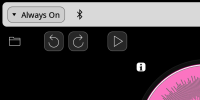
Profile selector popup menu. - Tap on the user interface element that you want to trigger or control with MIDI. This will pop up the MIDI Learn panel. The upper portion of the window has the options for the action being learned.. The lower part of the panel displays the MIDI message once it has been learned.
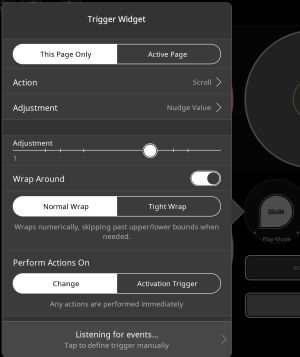
- Touch the control on your MIDI device that you want to control/trigger the user interface element.
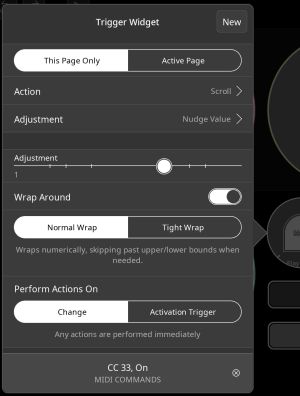
After learning a MIDI message, the learned message is displayed. Tap on the lower panel, to edit the message or its options. Tap on New at the top of the panel to learn another action for this object. - Optional: make adjustments to the learned event. The MIDI Learn panel has an upper region with options for the type of element you are controlling. The bottom part displays information about the message. Tapping on it provides some options related to interpretation of the incoming message such as whether to use On or Off as a trigger or Hold or Double-tap and more advanced options.
- Optional: refine or add to the binding in Loopy Pro's Control Settings. MIDI Learn creates a binding in Control Settings that can trigger a series of actions rather than just a single one.


MIDI Learn Plugin Elements
You can MIDI Learn an AUv3 plugin's parameters and actions that control it (open and close its window, enable and disable it, and more).
If the plug-in is visible in the mixer when in MIDI Learn mode, tap on the plugin's icon to bring up a popup menu of the learnable actions:

If the plugins window is open, there will be an added knob that is used to access the learnable actions. Tap on the knob to pop up a list of learnable actions. To learn a parameter via an onscreen control, interact with a user-interface element in the plugin's window. If it is tied to a learnable parameter, the knob will blink. Tap on the knob to learn that parameter.
 |
|
Using MIDI Learn to Manually Set Up A Binding
Bindings
Bindings are mappings of triggers (usually MIDI messages or keypresses on a typing keyboard) to Loopy Pro actions. A binding can trigger a single action or a series of actions. When you MIDI Learn, Loopy Pro creates a binding that is stored in a profile that you can access via the Control Settings menu. You can edit this bindings to create series of actions or refine the binding's options.
More about actions and action sequences: See Actions Tips and Loopy Pro manual's the actions sections
Control Profiles
MIDI Bindings are are stored in control profiles (or just profiles). Project profiles are local to the project. You should generally create bindings here for elements particular to the layout -- especially any widgets (sliders, buttons, etc). Global Profiles are bindings available to all projects. These generally should not be bindings to widgets and other local elements.
Profiles can be activated and deactivated in the Control Settings panel using the check "box" next to the profile name.
Loopy Pro has actions to activate, deactivate, and switch control profiles.
MIDI Controllers
Any MIDI source visible to Loopy Pro, including AUv3 that send MIDI, can trigger MIDI bindings.
Footswitch Note
Pretty much any footswitch can be used with Loopy Pro. For the best MIDI Learn experience, a footswitch should be set up to send an ON message (cc value 127 or note velocity 127) when pressed and an OFF message (CC value 0 or note velocity 0) when released. Other setups can work but may need manual editing of the learned event. For instance, if a footswitch only sends an ON message, Loopy Pro will interpret that as a HOLD. You can manually reassign that to ON.
See MIDI Troubleshooting and Footswitches for more information about footswitch setup.